
Investigating the Impact of Title IX Sexual Harassment Policies on the K-12 Experience
Authors:
Sexual harassment in schools remains a critical issue affecting students' safety, well-being, and academic success. Title IX policies aim to address and prevent sexual harassment and discrimination in educational settings, but their implementation in K-12 schools has sparked debate. This conference paper explores how Title IX sexual harassment policies shape the K-12 experience, examining their effects on students, educators, and school environments.

Understanding Title IX and Its Role in K-12 Schools
Title IX is a federal civil rights law passed in 1972 that prohibits sex-based discrimination in any education program or activity receiving federal funding. While originally focused on gender equity in sports, Title IX has expanded to cover sexual harassment and assault, requiring schools to take steps to prevent and respond to such incidents.
In K-12 schools, Title IX policies require administrators to:
Investigate reports of sexual harassment promptly and fairly
Provide support and accommodations to affected students
Implement prevention programs and training for staff and students
Ensure a safe learning environment free from discrimination
These policies aim to protect students from harassment that can disrupt their education and emotional health.
Research Questions
1. What do students know about sexual harassment policies as required by Title IX?
2. What are the experiences of K-12 students with sexual harassment?
Data Source
The study sample included freshman undergraduates at a southern, public Research I university. Surveys were distributed via university email, and participation was voluntary. Students were informed about the survey content and could opt out or exit at any time. The survey comprised three parts: (1) demographic characteristics, (2) knowledge and experience with sexual harassment, and (3) overall comments regarding sexual harassment in K-12 settings. For the current study, we focused on parts 1 and 2.
Methods
Demographic statistics for the sample of participants are shown in Table 1.
Table 1
Participant Descriptive Information

For open-response items, grounded theory was used, allowing open coding of main ideas, with double-coding when necessary (Glaser & Strauss, 1967). Analysis continued using the constant comparative method (Glaser & Strauss, 1967) across multiple rounds.
Findings
In looking at exposure to Title IX during K-12 (see Table 3), 55.8% indicated no knowledge of their district’s Title IX policy, no discussion of what constitutes sexual harassment (55.8%), no knowledge of a Title IX coordinator (63.5%), and 76.2% did not know the process for reporting.
Table 3
K-12 Background

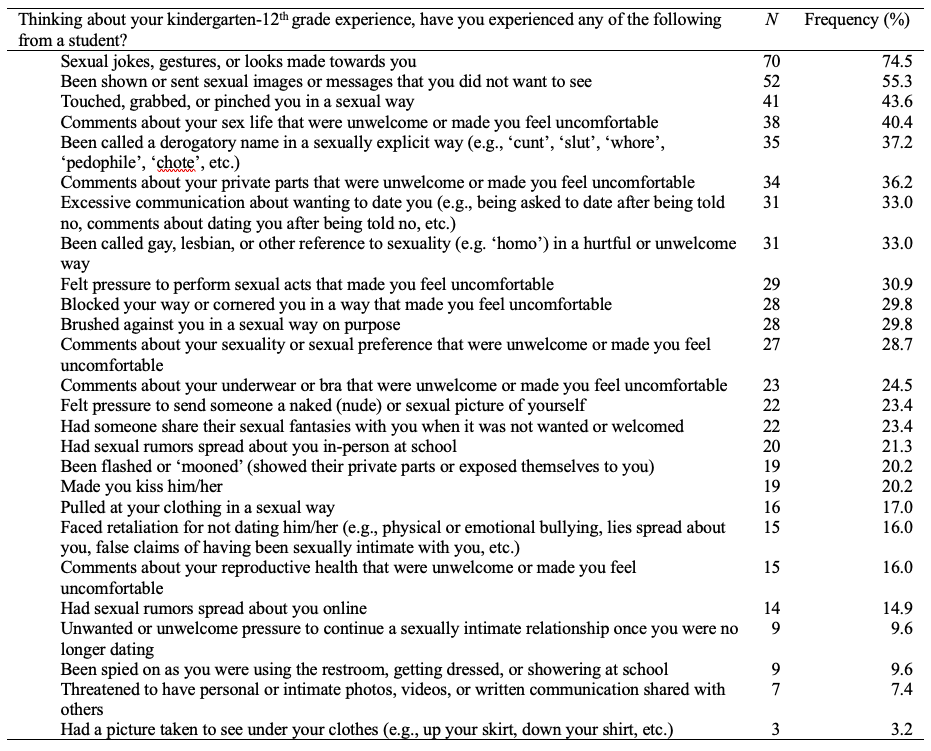
Regarding experience with specific examples of sexual harassment, 51.9% indicated experiencing at least one form of sexual harassment for a total of 645 individual incidents (shown in Table 4).
Table 4
Occurrence of Sexual Harassment Experiences by Indicating Responses
We next looked to identify any trends regarding these experiences, including gender, ethnicity, and diagnosed impairment (see Figure 1). Additional data was collected regarding sexual harassment location, grade level, and offender (see Figure 2).
Figure 1
Participants Reported Experiencing Sexual Harassment (Demographics)

Figure 2
Participants Reported Experiencing Sexual Harassment (Incident Details)

Next, we examined participants' decisions about reporting harassment and identified themes within each. 47.1% of identified sexual harassment incidents completed open-response items.
Reported Sexual Harassment
6.7% of sexual harassment incidents were reported by participants, with 2.8% providing details regarding their experience.

Inactive Response
Inactive responses to reported sexual harassment included the sub-themes of Nothing: “I reported it to a teacher and then nothing happened” (61) and “I reported it to my counselor. Nothing was done about it” (27); Not Believed: “[administration] couldn't do anything since I had no concrete evidence. I knew who they were, and I had screenshots to prove it, but at a small private school, no one really wants to incriminate the popular kids whose parents donate more than yours” (36); and Avoid Contact: after reporting a fellow student threatening to kill himself if the victim did not “accept him”, the administration’s response was simply to “just swap our classes” (67).
Active Response
There were a few examples of active responses to harassment reports, including having the offender “give me a public apology” (61) and school officials had a “talk to the boys about not saying things we don't know the meaning of” (49). The victim, however, did not feel the response was sufficient, adding, “The school did nothing.”
Did Not Report Sexual Harassment
72.7% (n=469) of sexual harassment incidents were not reported, with 44.3% providing details as to their reasons. Main themes included normalization, retaliation, justification, external factors, and ignorance, with sub-themes in each.

Normalization
Responses fell within two themes: It is What it is: “every guy did it to girls so I thought it was normal” (30) and “it’s just easier as a woman to suck it up” (10); and Intimate Relationships: references to dating or intimate relationships with some participants struggling to decipher between harassment and consent: “[it’s] not a crime. I ‘consented’ but still felt violated” (90).
Retaliation
Participants highlighted the themes of Controversy: “it would’ve caused me social trouble” (10); and Fear: “I was embarrassed and worried I would be blamed” (58), and “it was before it was a thing in the media to accept the LGBT community, so most people wouldn’t discriminated against me if I came forward” (16).
Justification
Excused: “it seemed like a waste of time” (32), “not severe enough need to” (49), and “it was just locker room talk” (110); and Easier: “too much to go through” (12).
External Factors
These responses highlighted external factors including Distrust: “my high school was run by people that definitely did not like that I was gay so they wouldn’t have done anything”; and Embarrassed: “I was embarrassed and worried I would be blamed” (58) and “I was too embarrassed to make a big deal out of it” (35).
Ignorance
There existed a lack of knowledge that sexual harassment could be reported: “I did not know that comments like that could be reported” (46), “I didn’t know I could” (59), and “I spent a lot of time with people who were not informed about stuff like this” (45).
Significance
First, participants reported a lack of understanding about which behaviors should be reported. Schools should ensure that all students are provided with age-appropriate education regarding what sexual harassment is. Second, participants overwhelmingly lacked knowledge of the available reporting processes. Title IX requires schools to have processes in place for reporting sexual harassment and thus should make these widely known to students. Finally, students reported factors impacting their decision to report harassment, including distrust and fear. For school leaders, these findings should be a call to change. Campuses should create environments where no student fears adult reaction to reports of sexual harassment. Further, as schools create opportunities for dialogue with students, the stigma surrounding sexual harassment can be diminished.


